
Category: Uncategorized

Doctors’ abortion guidelines will not be finished by January deadline
Doctors’ abortion guidelines will not be finished by January deadline
New guidelines for doctors on abortion will not be ready in time for the planned roll-out in January.
The Medical Council says it is better to get the guidelines right rather than rush them ahead of the Government’s deadline.
An extraordinary general meeting of the ICGP at the weekend was told by Medical Council president Rita Doyle that revised guidance for doctors in relation to abortion provision and conscientious objection would not be ready for January 1, according to a source.
It means existing rules on conscientious objection, which have been criticised by some doctors, will continue to apply.
Dr Peter Boylan, who is in charge of overseeing the roll-out, says it is inevitable there will be problems and that nobody should expect perfection from the start.
Digital Desk
Source: The Irish Examiner

Doctors stage walkout at meeting over abortion services
Up to 50 GPs walked out of an Extraordinary General Meeting of the Irish College of General Practitioners today, complaining that their voices have not been heard ahead of the introduction of abortion services in January.
The group of largely anti-abortion doctors wanted to vote on a series of motions but were refused that request.
More than 300 doctors attended the meeting.
A GP-led abortion service is expected to be introduced from January 2019, once the legislation is passed in the Dáil.
@SimonHarrisTD (Twitter)
Doctors and healthcare professionals have a right to conscientious objection. Women also have a right to healthcare though. One right cannot trump another. Just like all citizens, doctors have different views and that’s ok. But the people have spoken and the campaign is over
Hundreds of GPs have already said they will not provide the service because they have a conscientious objection to abortion.
The Irish College of General Practitioners is the professional and training body for family doctors.
Hundreds of its members petitioned to hold today’s EGM.
Some are conscientious objectors and do not wish to provide the service to women, while others are concerned about how they will manage the extra work load.
The ICGP said the purpose of the meeting was to consult and listen to members.
In a statement this evening, the ICGP said it was “disappointed” at the decision of GPs to stage a walk-out.
It said over 250 members stayed for a meaningful debate, where a range of views were heard from the floor.
Dr Tony Cox, Medical Director of the ICGP, said: “The College’s remit is to provide training and education for all GPs, and for those GPs who wish to offer this service.
“We are aware of the concerns of those with a conscientious objection to providing termination of pregnancy services, and we have successfully advocated for an ‘opt-in’ service and for a 24-hour helpline as the first point of information for those who seek the service.”
He added: “We are sorry that those who walked out didn’t stay to listen, as there was a meaningful discussion of all the issues on the agenda.”
Meanwhile, Minister for Health Simon Harris has said he is confident there will be enough doctors to provide abortion services from January, despite conscientious objections.
Minister Harris said contracts have been agreed and expressions of interest have been sent to GPs.
The termination of a pregnancy up to nine weeks will be introduced in Ireland from the beginning of next month, following the repeal of the Eighth Amendment.
Mr Harris said that while the law on abortion is changing, the rules around conscientious objections are not.
He said: “No doctor, no nurse or no midwife will be made or forced to provide a service they conscientiously object to, but equally no woman in the country will be left without access to healthcare that will be legal.”
Mr Harris said he hopes the reaching of a deal with the Irish Medical Organisation last month, on the provision of abortions in community settings, will result in more doctors being willing to provide the service.
He also said the HSE is setting up a 24-hour helpline, that will be a first point of call for women and which will provide information on where abortion services may be available.
Additional reporting: Fergal O’Brien
Source: RTE.ie

GPs to hold EGM on new abortion law
Family doctors who will be asked to carry out medical abortions under the proposed new law are to hold an extraordinary general meeting to discuss the issue.
The Irish College of General Practitioners said it will hold the meeting of its members in early December.
The meeting is expected to hear a range of concerns by doctors about freedom of conscience and reluctance of anti-abortion doctors to refer a woman for an abortion to a colleague. There are also worries about workload, support services and fears of surgeries being picketed.
The Nurses4Life group has also written to the Irish Nurses and Midwives Organisation (INMO).
An INMO spokesman said it respects the right to conscientious objection. It was debated and decided by members at its AGM. It is closely monitoring the legislation and engaging with employers to ensure this position is upheld. It will shortly hold a meeting of relevant professional groupings within its membership to brief them on the legislation.
Author: Eilish O’Regan
Source: Irish Independent

Blaming doctors for political decisions – IMO Opinion Post
Sir, – I was disappointed to hear the Taoiseach say that despite more doctors working in Ireland there has been no corresponding increase in activity (“Doctors’ pay to absorb ‘big chunk’ of extra ¤1 billion for health”, Dáil Report, October 23rd).
This is at odds with what the Department of Health has published in the Health in Ireland Key Trends 2017 report, which noted emergency department attendances were up 5.1 per cent, there was increased surgical day case work (up in excess of 70 per cent over 10 years), and that out-patient assessments reached 3.3 million annually (up approximately 1 per cent in a single year).
There has been a 12.6 per cent reduction in acute hospital beds (a political decision) between 2007 and 2016, with the result that waiting lists are extending and overcrowding of hospitals increasing, and yet in-patient discharges annually are in excess of 635,000, which is an increase of 7 per cent over 10 years.
Subjecting consultants appointed since 2012 to a pay cut three times that of any other public sector worker is the cause of 463 unfilled senior hospital specialist positions in Ireland.
Paying people doing the same job significantly less than their colleagues who were appointed prior to 2012 has devalued the work of those individuals and has had a very negative impact on doctors at what should be among the most productive years of their careers.
Rolling theatre closures; closed beds and wards; insufficient hospital, rehabilitation and intensive-care beds, with 20 per cent of hospital beds occupied by patients who could receive their care in alternate settings; daily postponements of operating lists; ageing equipment; as well as insufficient consultants in Ireland, all contribute to less activity than might otherwise be achieved.
Politicians called for the 30 per cent cut; it is they who are responsible for the consequences of their decision and they who can deliver the solution. – Yours, etc,
PEADAR GILLIGAN,
President,
Irish Medical Organisation
Doctors’ fear over mental health care for children
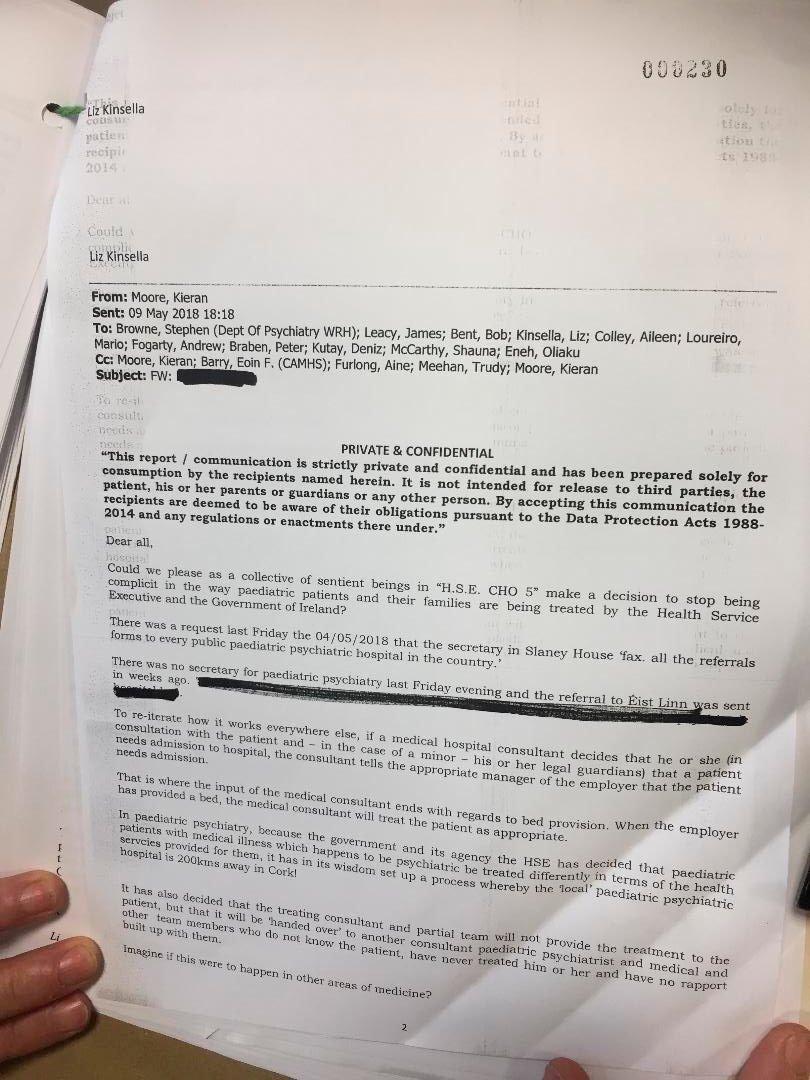
The chronic shortage of child mental health services in the South East resulted in suicidal children being hospitalised – some for several days – over a four-year period, while they waited to be seen by a specialist psychiatrist.
A concerned staff member at the Child and Adolescent Mental Health Services (CAMHS) reported the practice to the Ombudsman in 2016, according to an internal review of the service in the South East.
The lack of consistent consultant cover had been going on for four years and “up to 60 children had been affected”, according to the internal review of one of the most chronically under-resourced child and adolescent services in the country.
It was prepared for the Health Service Executive’s mental health service’s division, in response to the shortage of psychiatric beds for children and adolescents. The review was among documents released to the Sunday Independent under the Freedom of Information Act that raise concerns about the CAMHS service in the South East, where three psychiatrists resigned during the summer.
They reflect broader concerns about a system beset by staff shortages and long waiting lists across most parts of the county, with 2,615 currently on a waiting list and 356 waiting more than a year.
The undated review highlights the lack of psychiatric day beds or in-patient beds for children and teenagers in a catchment area covering South Tipperary, Waterford, Wexford and Carlow and Kilkenny. Children travel long distances and wait for months for beds in other regions.
The report proposed referring patients to private specialist psychiatrists with direct access to private beds until the HSE is in a position to provide public beds. It highlighted an “urgent clinical requirement” for an out-of-hours child and adolescent service, in keeping with international standards.
It noted an out-of-hours service in Waterford/Wexford was provided by a locum psychiatrist who was not on the specialist register for dealing with children. In South Tipperary, Carlow and Kilkenny, another out-of-hours service was provided by an adult or old age psychiatry consultant. This needed to be addressed “as a matter of priority”.
A second document highlighted how consultants in adult psychiatry who had traditionally provided out-of-hours care for children in Waterford and Wexford had withdrawn their cover two years ago. They believed the Medical Protection Society would not cover them in the event of complaints to the Medical Council because children were not their speciality.
The report suggested adult psychiatry consultants in other areas who found themselves treating children out of hours could follow suit and called for a national strategy.
Dr Kieran Moore, who resigned as a CAMHS psychiatrist in July, repeatedly raised concerns.
He warned management that treating children in adult psychiatric hospitals “clearly interferes with their human rights and I couldn’t ethically, morally or contractually have anything to do with such practice”.
In another, Dr Moore wrote that “the risk of serious morbidity and potential mortality continues to be high due to the lack of resources”; describing the local paediatric psychiatry service as an “absolute hell hole”.
Dr Moore was one of seven consultants who boycotted a CAMHS consultants forum in May this year. “As medical practitioners, we cannot engage in unsafe medical systems set up by the employer,” they wrote in a joint letter.
The HSE said it was working on “filling any vacancies” in the South East via a national recruitment campaign.
“The HSE’s South East Community Healthcare services wish to assure the public that it is there to care and provide support, has dedicated teams of professionals in place and that the welfare of service users and their families is paramount,” it said.
Author: Maeve Sheehan
Source: Sunday Independent

Cannabis-based medicinal products to be made available in Northern Ireland
Cannabis-based medicinal products are set to be made available in Northern Ireland.
The Department of Health has announced that it is taking measures to enable patients for the first time to be prescribed cannabis-based medicinal products without a licence.
The change will come into force on November 1.
It mirrors similar changes which will occur in England, Wales and Scotland.
The new regulations come following several high-profile cases, including that of young epilepsy sufferer Billy Caldwell from Castlederg, Co Tyrone.
Billy Caldwell, who has a rare form of epilepsy, with his mother Charlotte in Belfast city centre (Brian Lawless/PA)
His mother Charlotte led a campaign to allow her son to be treated with medicinal cannabis products, saying it helps to ease his symptoms.
Northern Ireland’s Department of Health says the amendments implement the recent expert advice from the Chief Medical Adviser to the UK Government and the Advisory Council on the Misuse of Drugs (ACMD) in relation to cannabis-based medicines and will ensure a consistent approach in terms of regulation and patient access across the UK.
In a statement, the department said it has worked alongside the Home Office, the Department of Health and Social Care (DHSC), and the Medicines and Healthcare products Regulatory Agency (MHRA) to develop additional frameworks and clinical guidelines to ensure that cannabis-based medicinal products can be prescribed safely and effectively to patients while at the same time ensuring they are not misused.
However the department has pointed out that the rescheduling of cannabis-based medicinal products does not pave the way towards legalising cannabis for recreational use.
The penalties for unauthorised supply and possession will remain unchanged.
Doctors on the General Medical Council’s specialist register will be able to decide to prescribe cannabis-based medicinal products where their use is deemed clinically appropriate and in the best interests of patients.- Press Association
Source: Breaking News

Norway: Supreme Court upholds rights of doctor who refused abortion procedure
Health authorities in Norway have been told to respect medical professionals’ right to conscientious objection after the country’s Supreme Court found in favour of a doctor who refused to administer a procedure that could have resulted in an abortion.
In a judgment published yesterday, the court found that Dr Katarzyna Jachimowicz acted within her rights when refusing to follow through with a medical procedure to which she had a moral objection.
In 2015, Dr Jachimowicz lost her employment with a general practitioner clinic in the municipality of Sauherad.
She had refused to insert intrauterine devices (IUDs), which can act as abortifacients, because administering a procedure that could result in abortion contradicted her Christian faith.
Her superiors fired Dr Jachimowicz because she failed to comply with an instruction that she considered to be morally wrong.
A lower court found that she had acted within her right to practise medicine in accordance with her conscience but healthcare authorities appealed the decision. The case was then heard at the Supreme Court at the end of August.
Håkon Bleken, who represented Dr Jachimowicz before the court, said: “[The] Supreme Court decision marks an important step in the right direction, not only for doctors, but for people of faith in all professions.
“The ruling protects one of the most fundamental rights, the right to act in accordance with one’s deeply held beliefs. Dr Jachimowicz takes her vocation as a medical professional seriously. She vowed to protect life, and objected to having any part in taking it. The court established […] that she had every right to do so.”
Robert Clarke, director of European Advocacy for ADF International, a human rights organisation that supported the case, said: “Nobody should be forced to choose between following their conscience or pursuing their profession. We welcome this ruling from the Norwegian Supreme Court.
“It will set new standards for the protection of fundamental conscience rights in Norway and beyond. The court’s findings recognise the fundamental right to conscientious objection for medical staff, as protected by international law.”
He added: “This win comes at a time when medical professionals across Europe are feeling increasingly threatened in their positions by a pressure to do things they believe to be morally wrong and unethical.
“As such, it provides a valuable legal precedent in protecting this inherent freedom across the continent. This judgment sends a clear message to the Norwegian authorities that conscience is a fundamental right under the European Convention on Human Rights which must be protected.
Source: IrishLegal.com

GPs want opt-out on abortion to be protected in law
The Irish Human Rights and Equality Commission (IHREC) has asked Simon Harris, the health minister, to establish an early registration system for doctors who conscientiously object to abortion. It also wants Harris to broaden the category of care-providers to which objecting doctors can refer pregnant women and girls.
Following the referendum in May, some doctors who were opposed to removing the constitutional ban on abortion said they wanted to be protected from prosecution if they refused to refer women to GPs willing to perform terminations.
The IHREC has made a submission on the Health (Regulation of Termination of Pregnancy) Bill 2018 which Harris is to introduce in the Dail this week. The bill states there is no obligation for “a medical practitioner, nurse or midwife [to] carry out, or to participate in carrying out, a termination of pregnancy” but those with conscientious objections must make “arrangements for the transfer of care of the pregnant woman concerned”.
The commission wants Harris to provide for referral to other professionals, not just doctors, and to underpin legislation with regulatory guidelines “for expeditious transfer of care”.
Its submission refers to a recent collective complaint [about access to abortion] against Italy, where many medical practitioners were exercising the right to conscientiously object to carrying out the termination of pregnancies, made to the Council of Europe committee on social rights.
The committee ruled that abortion services must be organised to ensure patients’ needs are met, particularly for time-sensitive procedures such as abortion.
The IHREC says “provision for advance declaration and registration of conscientious objection by medical practitioners may assist medical institutions to effectively plan for, and accommodate, conscientious objection and identify gaps in effective access to services”.
Emily Logan, the chief commissioner of IHREC, said: “The right to conscientious objection needs to be effectively balanced with women’s and girls’ rights to legal medical care, and that access to a termination of pregnancy should not be determined by what part of the country you live in.”
Peter Fitzpatrick, a Fine Gael TD for Louth, is expected to vote against the bill. He would not comment on his voting intentions last week but confirmed he would be making an announcement about his political future on Tuesday, when he is expected to redesignate himself as an independent TD.
He is likely to be asked by independent TDs Mattie McGrath and Michael Collins to join their planned new “pro-life, pro-rural Ireland” party, but sources close to the TD said he would not be interested.
The former Louth football manager did not allow his name to go before Fine Gael’s selection convention last week. Sitting TD Fergus O’Dowd and councillor John McGahon were chosen as the party’s candidates for the next general election.
Author: NIALL CARSON
Source: THE TIMES

Concerns over jail threat to doctors
A medical law expert and a patient safety advocate have both urged a rethink of provisions in the Patient Safety Bill that would criminalise medical practitioners for failure to disclose information in relation to serious mistakes.
Simon Mills, a barrister and former doctor, and Bernie O’Reilly of the Patients for Patient Safety initiative — who lost her husband to medical misadventure — said the aim should be to foster a culture of willing open disclosure instead of threatening medics with jail.
Mr Mills said the open disclosure provisions of the Civil Liability Amendment Act 2017, which come into effect today, should be given time to bed in. Instead there was a “rush to criminalise”.
The 2017 Act was designed to encourage open disclosure by enabling an apology to be made without it invalidating a practitioner’s insurance or being taken as an admission of liability in court.
It was also intended to give the medical regulatory bodies stronger grounds on which to commence fitness to practice proceedings and/or sanction a practitioner.
The proposed Patient Safety Bill goes a step further by making open disclosure a legal duty under threat of criminal prosecution, fines of up to €7,000 and/or six months in prison.
Mr Mills said there may be an argument for institutions to be made criminally liable but targetting individuals was a rushed response to the CervicalCheck scandal.
“Politicians need to be seen to do something,” he said.
“We have two parallel systems in train. One is creating space for open disclosure to take place and the other is, without waiting to see whether that fixes the problem, raising the idea of criminalising individuals or systems and it seems to me for the two of those to be proceeding in parallel rather than sequentially may well turn out to be a mistake.”
Ms O’Reilly spent years trying to get the truth behind her husband Tony’s death after bowel surgery in 2006 and still has unanswered questions which she said might have been answered if there had been automatic preservation of all materials relating to his case and timely disclosure of the events that went wrong.
However, she added: “I don’t think anybody should be criminalised. I think when something awful like that happens, you should learn from it and involve the family in that learning.”
Mr Mills and Ms O’Reilly were addressing a conference hosted by the State Claims Agency which heard the agency was currently handling 3,342 medical negligence claims and 7,579 general personal injury claims with a total estimated liability of €3.2bn, of which the medical negligence claims made up €2.32bn.
Former doctor Adam Kay, now comedian and author of This Is Going To Hurt, his diaries from his time as a physician, said health services also needed to review the way they treated staff involved in serious incidents.
Mr Kay said it was not until he was published that those close to him realised he had left the profession in devastation over a tragic case which he only attended when it had already become an emergency but which still had a profound effect on him.
“I didn’t tell anyone,” he said. “There’s a stiff upper lip approach.”
He said he asked if he could work part-time for a while but the response was akin to: “Why? “Are you pregnant?”
“We don’t like to think of our doctors as human because when someone is looking at an MRI of your brain, you want them to be God or Google or something equally infallible,” said Mr Kay.
“Medical schools are not honest about what the job is. If you are going to be a train driver, they will do a psychological test on you.
“If you’re going on Big Brother they will check you’re not going to crack. But if you want to be a doctor all they will check is whether you have enough As in your grade.”
Author: Caroline O’Doherty
Source: The Irish Examiner